

Notes from Bombay
Notes from the Overground V

BOMBAY. Michaelmas term lately over, and advocates streaming from the High Court. Warm December weather. Neither muggy, nor stifling, and the sky as blue and as clear as can be, granting Rajabai Clock Tower the truest vision over Oval Maidan, where play all at once dozens of adolescent lads—bowling, batting, fielding. And, though those Gothic colossi, spired and steepled, are named new names, it would not be wonderful to meet a shining column, forty feet long or so, of the Imperial Police, marching in bright white uniforms and bright white pith helmets up the Esplanade (renamed Mahatma Gandhi Road), having just circumambulated Wellington Fountain (now on S. P. Mukherjee Chowk); for all those monuments to a lost civilisation, erected by the King’s most Excellent Majesty, by and with the advice and consent of the Lords Spiritual and Temporal, and Commons, and by the authority of the same, assembled, remain there even now.
People everywhere. People on the shorefront, where ferries come in to dock; people on ferries, where the jetties jut out into the bay. People on dhows. People on dongars. People on dinghies. People orbiting the Gateway of India, where Their Imperial Majesties landed on the Second of December MCMXI. People coming from the provinces: from Karnataka, where mummers improvise their Yakshagana; from Kerala with its Sadya smorgasbord, laid out in blotches on a banana leaf canvas; from Goa, four-hundred-and-fifty-one years Portuguese; from Gujarat, in swarms of schoolboys on school trips; from all over India, all of whom desiring to see their financial and cultural capital. People, citizens and visitors alike, navigate the busy streets in kaali-peeli taxis; among these black and yellow minnows occasionally a titan emerges, a motorcade of vehicles like some great leviathan cutting through the waves of traffic. The people hiding behind those blacked-out windows are themselves titans of wealth and celebrity; their armoured people carriers are modern sedan chairs, ensuring that their feet never once touch the dirt as they are transported to their skyscraper palaces. People on scooters converge from every direction around them, bearing friends, family, wives in niqabs or saris. People beep; people swerve; people narrowly avoid catastrophe. People screech up the Coastal Road upon a maelstrom of motorway, towards Worli, Bandra, Santacruz, suburbs and slums. And later, on another day, those same people will return to Fort, to the centre of Bombay, to the Victoria Terminus, on a commuter train, packed with ever more people. And still, all the while, advocates will stream regularly from the High Court, near the Oval Maidan, where the thwack of a bat marks the last ball in the last over, before the players break for tea.
—
MUMBAI. Marriage season in full swing, and the anniversary of Ambedkar approaching. The 6th of December—the 67th Mahaparinirvan Diwas—marks when B. R. Ambedkar left this mortal plane. It was Babasaheb Ambedkar, upon the foundation of the Indian state, who was its constitution’s artificer; of the Drafting Committee of the Constituent Assembly he was chair; and so THE PEOPLE OF INDIA, having solemnly resolved to constitute India into a SOVEREIGN DEMOCRATIC REPUBLIC and to secure to all its citizens JUSTICE, LIBERTY, EQUALITY and FRATERNITY did THEREBY ADOPT, ENACT AND GIVE TO THEMSELVES THAT CONSTITUTION. For it was the value of EQUALITY which so stirred Dr B. R. Ambedkar, who was Dalit by birth. Through much hardship he succeeded in education, law and politics; but he could never reconcile Hinduism, and its castes, with his belief in EQUALITY. Buddhism, of his own formulation, was his calling, and so to it he converted, and so too the Mahars of Maharashtra, four-hundred-thousand of whom en masse accompanying him. And still now, hard by the Gateway of India, a grandstand of arrayed scaffolding, constructed in celebration of Ambedkar’s Mahaparinirvana; and up the grand boulevards, and down the side roads, and around the corners, and within and surrounding the maidans, billboards and signs and stretched banners emblazoned with his face; and then the soldiers, come bearing garlands, rich with blooming colour, who salute him with reverence and respect: JAI BHIM!
All throughout Mumbai are other signs, billboards, advertisements. They line the highways, hang from fences, rest against walls and curbs. They range from cardboard or paper scraps, quick to melt into the heat and rain, to vast hoardings, bounded by steel frames. They are a view into the mind of the Mumbaikar, or, at least, the mind of the Mumbaikar advertising executive. Some are commercial. Some are political. Some are both. One presents Durandhar, a controversial nationalist thriller, to the Indian public. Another markets condominiums in a new town, replete with amenities, in the north of the city. One celebrates an industrial milestone: one billion tons, or one-hundred crore, or ten-thousand lakhs, of coal produced in India in a year. Another depicts Vladimir Putin and Narendra Modi shaking hands and smiling, subtitled: “The handshake has set the tone. The stories carry it forward. RT. A NEW VOICE, FROM AN OLD FRIEND.”
—
In the seventeenth century of the Christian Æra, the empire of England comprehended a lesser part of the earth, being limited to divers outposts in the Orient and certain portions of the North American continent. The frontiers of that monarchy were not extensive, the illustrious renown and disciplined valour of such eminences as Clive or Cook not yet having emerged. None the less, in the year of our LORD sixteen-hundred-and-sixty-one the Seven Islands of Bombay were acquired as dowry upon the union of Charles II and Catherine of Braganza. The isles were leased to the East India Company, which established an administration there. Under the authority of the same, Anglo-Irish governor Gerald Aungier erected a church, setting its foundation stone in 1676. For it is an ancient tradition to lay such a stone, to signify Jesus Christ as the chief corner stone in whom all the building fitly framed together groweth unto an holy temple in the Lord. Verily, He may be called the most perfect ashlar, whom we which are as rough ashlar must needs emulate. As the foundation stone, and its signification, which is Christ, marketh the spiritual centre of man, so St. Thomas Cathedral, as it was afterward dedicated, marketh that of colonial Bombay.
The Cathedral itself is of a singular construction, the result of a Victorian restoration. The original structure is simple, raised with whitewashed stone and supported by Tuscan columns. Golden highlights brighten the façade. Ingrafted on the olden part is the Gothic chancel, where lies the altar, making the church, as such, composite. The interior is again simple, yet dignified, in the Anglican fashion. Refined metalwork embellishes this simplicity. Fans overhead cool its parishioners, ranged in pews of dark wood which rest on the grey-green tiled floor. The step up from the narthex reads “REVERENCE MY SANCTUARY.” At Evensong on Sunday November 3rd 1911 His Imperial Majesty King-Emperor George V did his reverence there, and his chair, and that of Queen-Empress Mary, is preserved to-day.
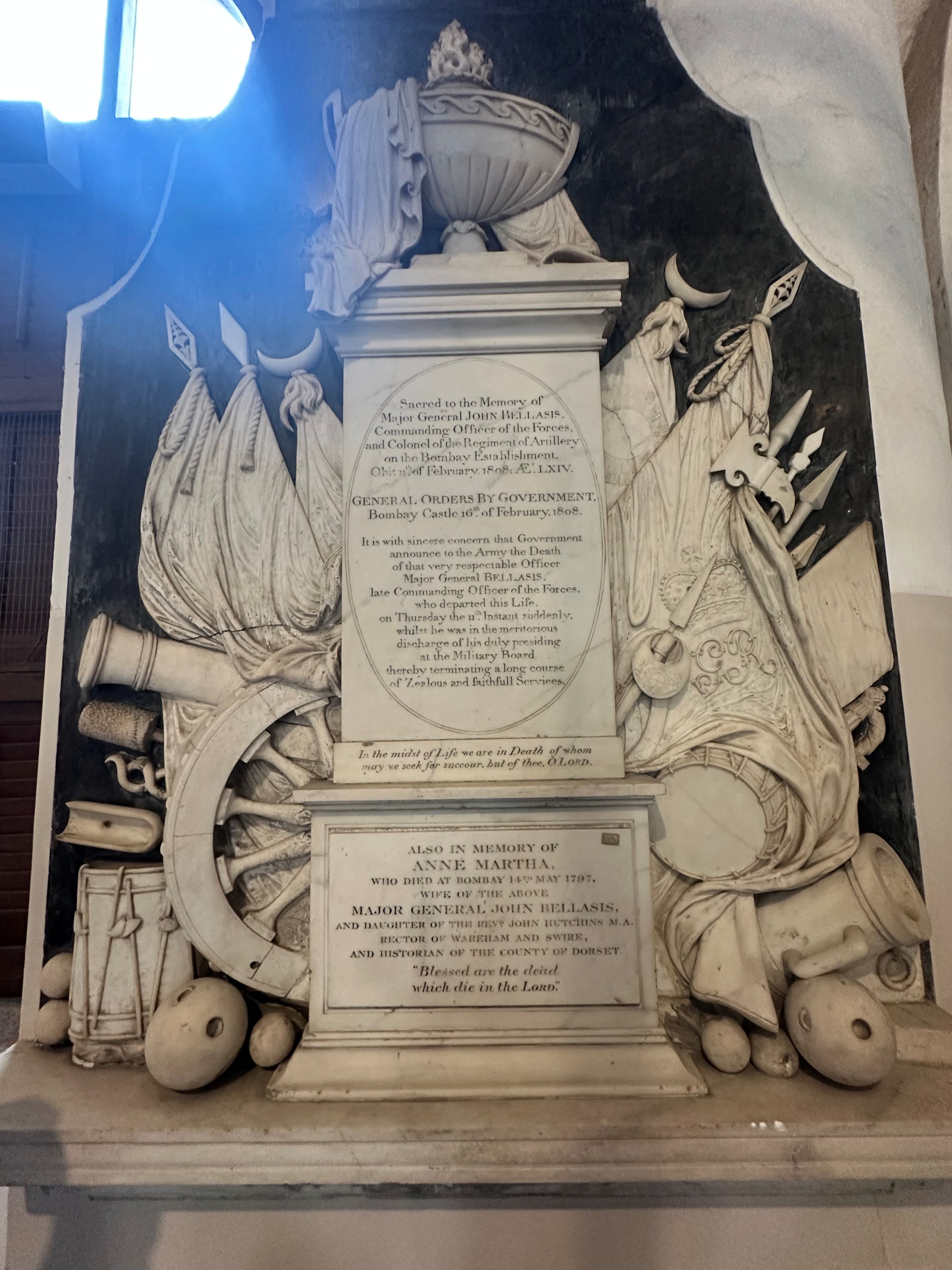
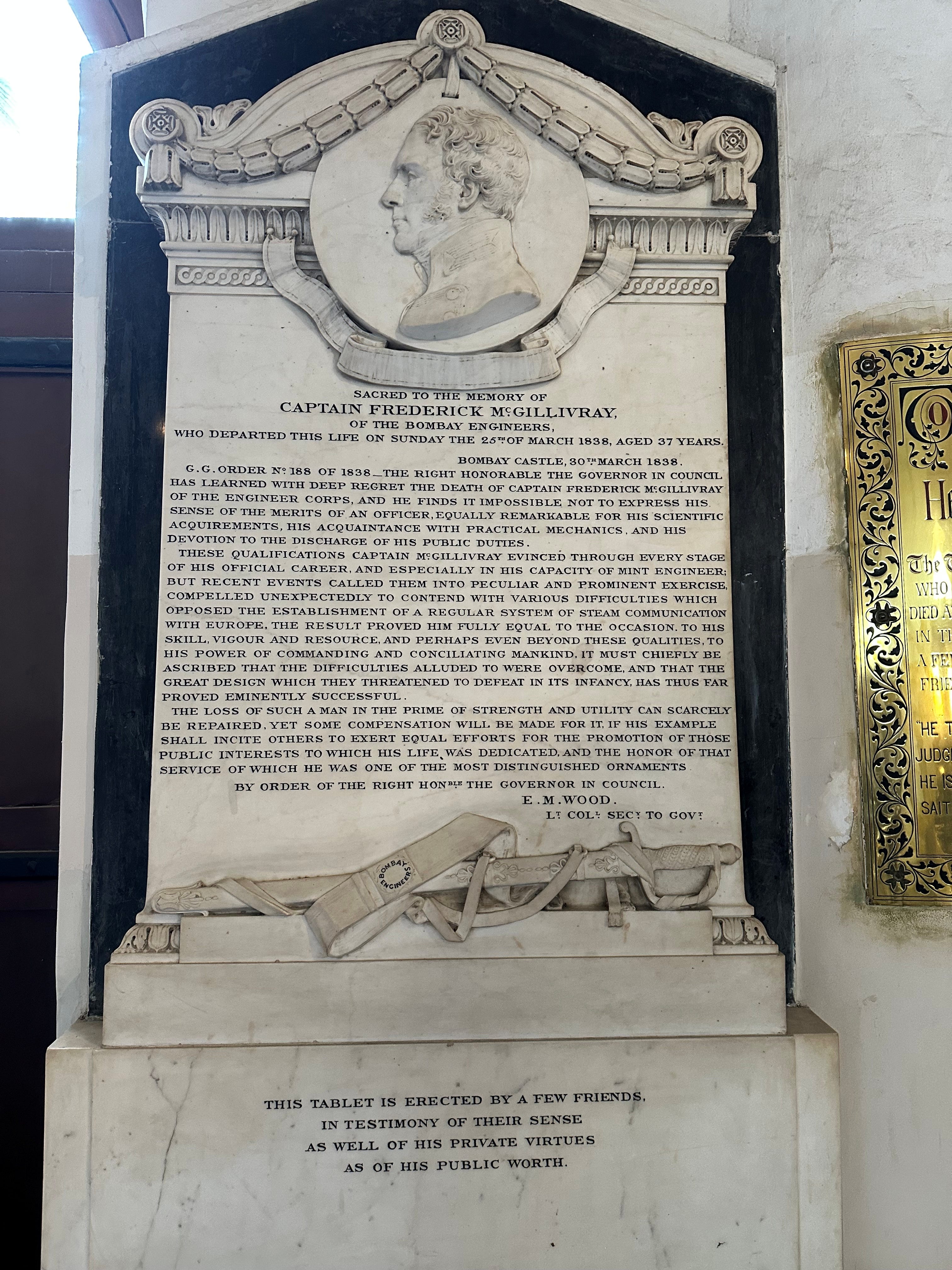
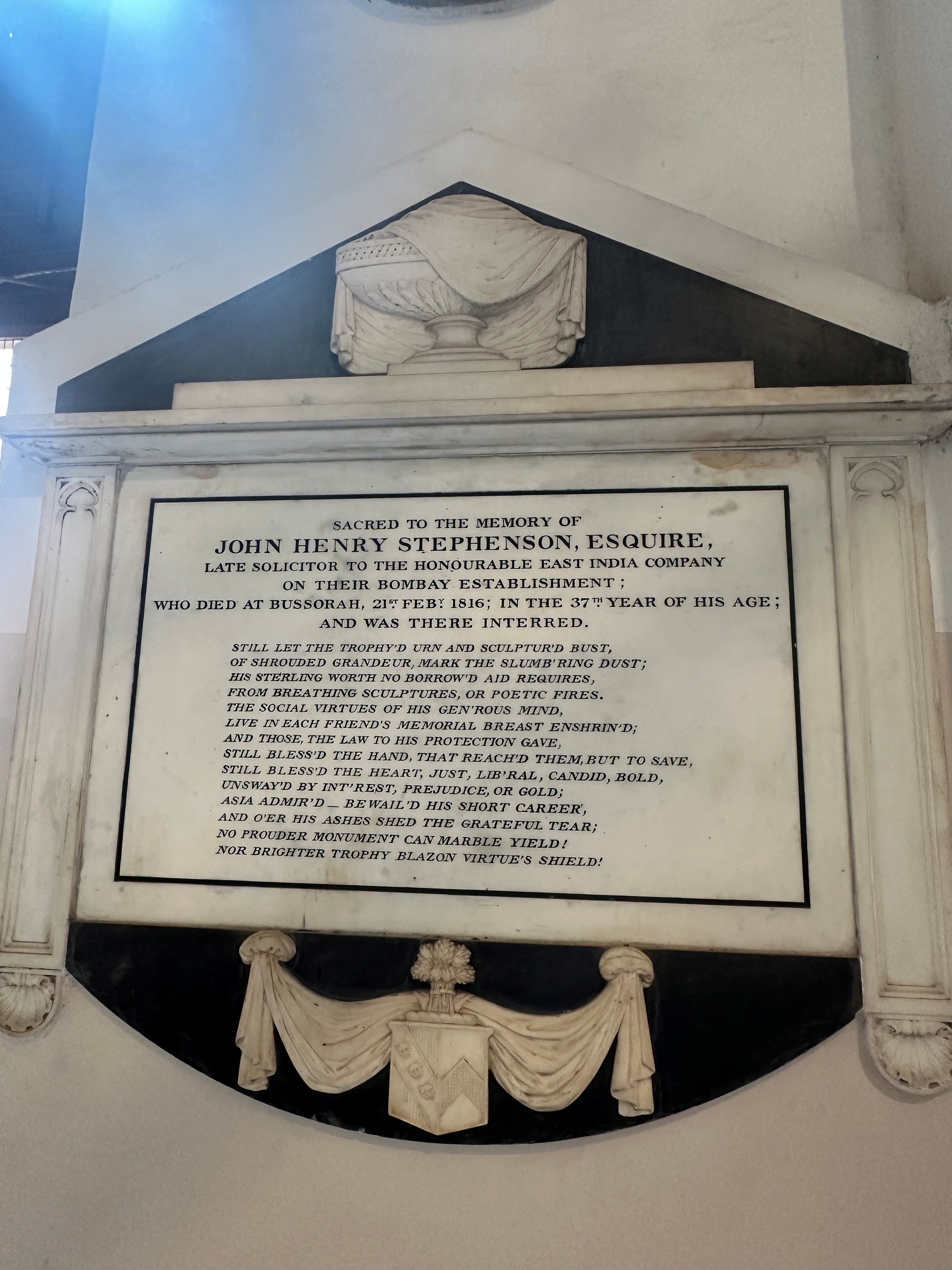
The most striking preservations in this temple are its memorials, to those men who perished for the East India Company, and the possessions of the broader British race. Here is a place that is for ever England. On every surface are whited sepulchres inscribed with British names and British fates. A carved marble anchor, draped with standards, commemorates the foundering of the Steam Frigate Cleopatra, and the loss of her crew. The memorial to Alexander Cumine Peat, Major in the Corps of Engineers at Bombay, is topped by alabaster versions of his cocked hat, banners, coat of arms, swords, cannon, flintlock and bugle. A funeral urn stands above an inscription dedicated to Thomas Mostyn Esq., Skilful in the Politics of HINDOSTAN, He resided several Years in a public CHARACTER at the MAHRATTA COURT… A Faithful Servant to the EAST INDIA COMPANY. Nearby, a stone soldier mourns in the shade of a palm, resting his elbow on the tomb of his commanding officer and recalling his glorious memory; for the palm of Lieutenant Colonel Charles Barton Burr, C.B., of the 1st Battalion, 7th Regiment, Bombay Native Infantry, was his signal victory, obtained over the Paishwa’s army, at Kirkee, on the 5th of November 1817.
Though those memorials be beautiful and ornate, yet their inhabitants repose there as strangers in a strange land; each in his narrow cell isolated from his forefathers, four-and-a-half-thousand miles distant. Their lives were perhaps characterised by glory, joy, ambition, even cruelty, and all the other natural affections of the human condition. Their afterlives on earth are marked by the respect of a tourist or two, and the maintenance of some few gentle Christian souls. For when the empire of England contracted, and the 1st Battalion of the Somerset Light Infantry passed through the Gateway of India for the very last time, those servants of the Crown and Company, fallen in the strict line of their duty, were left behind forever, aliens surrounded by those alien to them. A countryman, home sick on their behalf, might wander around the columns and through the nave, glimpsing in his mind’s eye a brief moment of each of their lives, and wonder, “to what end? Is here that English heaven?”
IN MEMORIAM
—
Wake! For the shade of Haji Ali calls
Us forth towards him. He, entombed, enthralls
the Muslim masses; while his spirit stirs,
around him more and more souls throng his halls.
At first you see pandaemonium—a great crashing together of roads, metal shells, automatons. Slip away down another pathway. Quieter, it leads away from the tumult. Around you, men with wrapped heads, families, boys, girls in hijab, imams and mystics in white turbans. Hawkers peddle their wares to all. They sell fabrics, stitched with divine words: the Basmala, takbir, shahada. Tomes stacked high extol the sheikhs, and ulama who interpret fiqh—Islamic jurisprudence—or they contain ahadith, sunnah of the prophet Muhammad (ﷺ). Everywhere are images of the Ka’bah, black and gold, the pilgrim’s final goal, the Baytullah! Keep pushing through the crowds. Follow them. They know the way. Suddenly a clearing, a no man’s land. Ahead, the Coastal Road, a jarring protrusion. An underpass permits your passage. As you approach it, the smells of garbage and feces clog your nose. Surrounding you, and the other pilgrims, is an industrial wasteland, a product of this excrescent construction. Dive into the underpass and these foul smells are replaced by those of sweat and sickly sewage. The pilgrims condense into columns: one towards Haji Ali; one returning therefrom. On the edges, more stalls, sellers, vendors. Shouting. Yelling. The pilgrims and peddlers stare at you as you pass. You see a light at the end of the tunnel.
A short while later, you emerge into sunlight. In front, in a white as white as a Haji’s ihram wraps, are the minaret, towers and dome of the shrine. Under that dome lies that Sufi saint from Central Asia. A causeway connects you to his dwelling place. The tides are out. Process forward. On that causeway are beggars, amputees, limbless men and women, crouching or kneeling, harassing the passers-by streaming across the strait. Now climb the steps, through the gateway, into the complex. Your party splits in two; men and women into separate sections. All to see the sepulchre. Pir Haji Ali Shah Bukhari is at the centre, coffin covered in ornamental blankets. He came here a companion of Ali Hamadani, who spread the deen in South Asia for the Kubrawiya order. On his death, his shroud was commended to the waves; coming to rest on the rocks of Worli, there his followers built his mausoleum. The Muslims of India journey here to pray. Here, they remember the Silk Road, with all its luxuries. Here, they remember that the Silk Road brought them the faith, with all its fortunes. Here, they recall those luxuries of Samarkand, described by travellers in times gone by; or, better yet, the luxuries of Jannah, in whose gardens they hope one day to dwell.
Rest now, ye pilgrims! For the day is done.
The sea has swallowed Sirāt, which no-one
who still remains on this corrupting earth,
can cross before his thread has been unspun!
—
Ekaa - a culinary odyssey.

—
On another night, in our taxi and having rumbled halfway back across Mumbai, we stopped at a red light. In yellow above glowed Antilia, the residence of the Ambani family, breaking through the horizon. Replacing an orphanage for the Khoja Isma’ili community, this skyscraper was built on steel stilts, supporting irregular square stacks of glass and concrete. There are six floors of car park, three helipads and six-hundred servants. The tower is a city within a city, a modern-day palace, a fortress for protecting its five residents against their own countrymen. Far below, at the junction we waited for green. New lights began to beam through our windows. A knock. And again. Outside the door stood a pixie-like thing, waifish, with an androgynous appearance. He (I think) was no more than ten, wore his hair short, had in his ears steel studs, and was crowned with a toy halo, bedecked with fairy lights, fluffily feathered. Eagerly and sweetly he knocked, attempting to sell his halo-wares, but coldly we responded, as our driver advised, staring vacantly into the distance, as if he were not there. More and more, and then more desperately, he knocked, with his hope accusing us. Finally, giving up, he let out an unneeded apology, “sorrreeee!!”, which tore through us, deservedly piercing our hearts with spears of shame.
—
Bandra is the trendy heart of Mumbai. North-west of the centre, its character is unique. Remaining under Portuguese suzerainty for another century after the Seven Islands of Bombay became British, it is possessed by a Catholic and Latin spirit. Everywhere around the neighbourhood crucifixes can be seen, on walls, outside houses, by the road-side. Raised over Him are those four letters: I.N.R.I., Jesus of Nazareth, King of the Jews. St Andrew’s Church, of Jesuit build, is the oldest and greatest relic of Bandra. Its sprawling funerary slabs record generations of parishioners: John. B Pereira, Louisa G. Pereira, Stephen A. Pereira; Albert Ignatius Fernandes, Yvonne Fernandes, Pamela M. Fernandes; Basil Gonsalves, Rose Victoria Gonsalves; the grace of our Lord Jesus Christ be with you all. Amen.
As Bandra looks out west onto the Indian Ocean, so too does it look towards the West. The area is stylish and fashionable, with countless boutiques and luxury shops. One boutique, among others, took Indian textiles, colours and patterns and expressed them in Western silhouettes. The designer was a sophisticated lady, who’d spent memorable time in Paris, New York and elsewhere. One other centre of fashion, London, was for her, unfortunately, different: “All I hear there are Indian languages, more even than in India. It’s dystopian.” What’s more, every time we asked about Mumbai, she responded by calling the city ‘Bombay.’
—
A traveller’s excursion
The Hindu gods inhabit the Elephanta Caves. Located on the eponymous island, this complex is dedicated to the praeternatural majesty of the Lord Shiva. Cut in basalt, the temples within are dated between the 5th and 9th centuries. To get there the traveller must embark from the jetties that jut out from India’s Gateway. A simple wooden ferry, not unlike Hong Kong’s Star Ferry, shall take him across Mumbai Harbour. During the journey of about an hour, it is possible to catch sight of the container ships Jawaharlal Nehru Port. These behemoths bring the gifts of trade to Maharashtra; they themselves gift the harbour a smoggy mist of pollution. While the ferry desperately chugs, asphyxiating on its own black fumes, and worsened by the harbour’s toxic smog, the tourist, oblivious of his slow poisoning, might discuss the islands with his tour-guide, domestic Indian tourists, or strangers. The Indian coast guard might then come upon the ferry; thereupon the captain might force all passengers to put their lifejackets on. The coast guards, of course, will pretend not to have seen anything.
Next, the traveller, with his accompanying party, will dock into Elephanta. He will take a theme-park-style choo-choo train across the island to the centre, where the stairs to ascend begin. As he and his party are thrown side to side by the decrepit locomotive, they will spot the island’s primary inhabitants: rhesus macaques. These little fellows cause chaos. They might steal the tourist’s sandwiches, or hat, or sunglasses. They screech and scream while they play, diving across the tourist’s path and climbing over the overhanging canvas roof that protects the tourist’s party from the sun. Yet when the travelling party climbs the stairs up to the complex, they should expect to be harassed not by the monkeys, but by the peddlers, and their speakerphones.
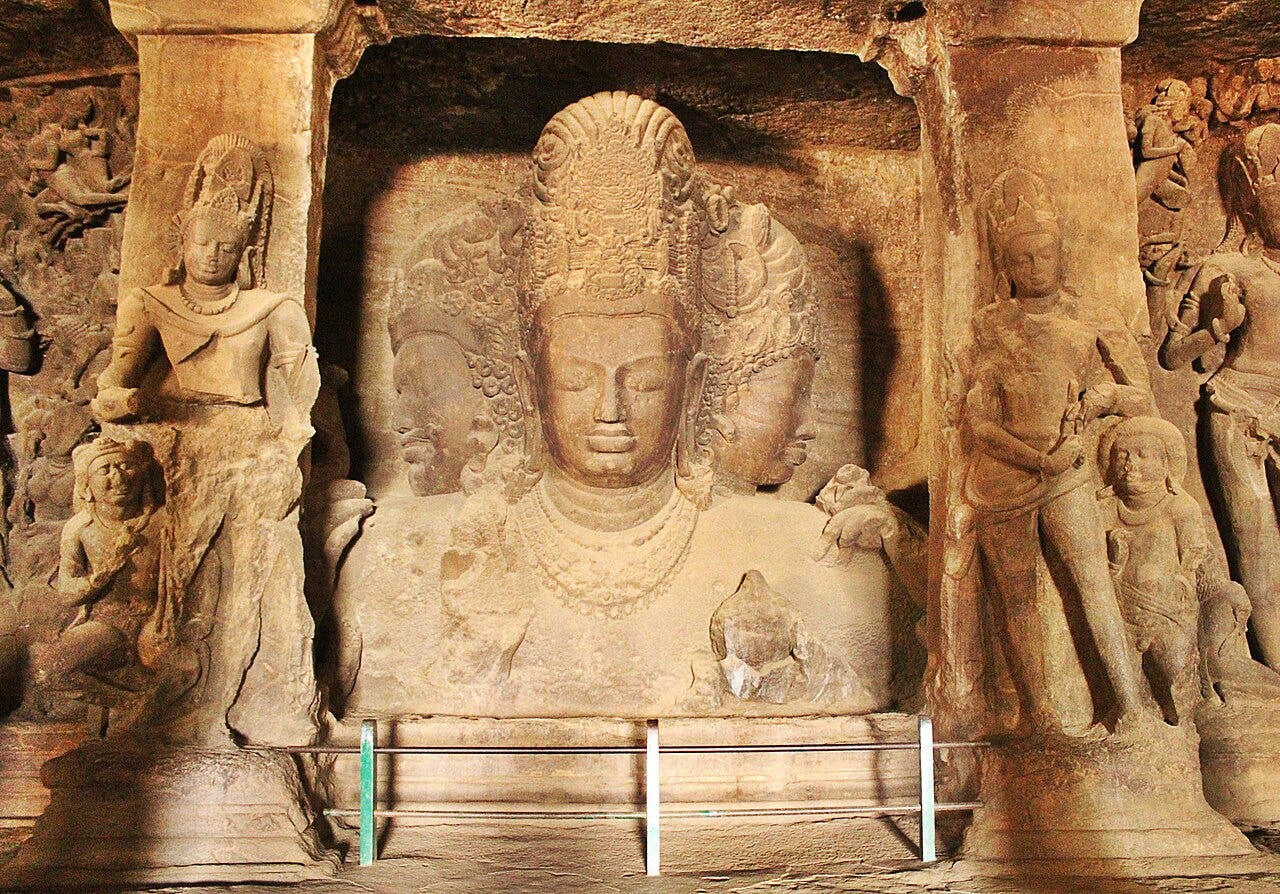
The cave-temples themselves are five in number. Only the first, and largest, is artistically and religiously notable; the other four are either unfinished or largely destroyed. The central feature lies at the far back of the cave, once the traveller has progressed past the cave’s opening pillars and past the cuboid-cut shrines. This is the Trimurti. Ordinarily, the Trimurti depicts the supreme triple-divinity of Brahma, Vishnu and Shiva, representing creation, preservation and destruction, respectively. Here, however, the depiction is Shaivite; Shiva is the supreme being; the Trimurti shows three aspects of Shiva. This is the Sadashiva. For Shaivites, Shiva is creator, preserver and destroyer altogether.
Another carving shall interest the curious traveller—that of the Nataraja, or Shiva, Lord of the Dance. For Shiva is the originator of all movement, and, surrounded by flames of destruction and flames of creation, he enacts the cosmic cycle. Elsewhere, on another wall, Shiva is depicted in his home, atop Mount Kailash, in the Himalayas. For Kailash is the axis mundi, the centre of the world, and the physical manifestation of Mount Meru, where converge all things in one. Kailasha is Shiva’s realm, where dwells he among crystal and snow, ice and crystal flows. Parvati, the Mother Goddess, resides there with him, as do their divine children Ganesh and Kartikeya. In this scene, traveller, the demon king Ravana attempts an upheaval—to raise Kailash and topple Shiva in his place. With his twenty arms Ravana tried in hubris; but Shiva had known, and with his big toe, crushed Ravana with the mountain itself.
“Fire is His head, the sun and moon His eyes, space His ears, the Vedas His speech, the wind His breath, the universe His heart. From His feet the Earth has originated. Verily, He is the inner self of all beings.” — the Upanishads.
—
In the same town, among other buildings which cycle always between construction, reconstruction and dilapidation, find Dharavi. North of Mumbai Central and south-east of Bandra, Dharavi measures one square mile; yet at least one million souls there do dwell. It was recommended to us that we visit, that we see clearly and fully the squalor of the slums, and that we dwell on the fact of their existence. The intended lesson was not that the inhabitants of Dharavi needed saving; rather, that they lived with dignity, even if not in dignity. Here, now, was one of the workshops of the world, replete with entrepreneurs, striving to escape from an endless state of want.
Our guide, a hustling Dharavi native, led us across a railway bridge, whose stairs plunged into the morass below. The earth under our feet was layered, mixed and pressed with detritus, crushed garbage, plastic bottles and bags. Vast potholes filled with dirty yellow water, eroding the road, required careful navigation. Stepping around them, and pursuing our expeditious escort, we entered Dharavi. Our first encounter was a Hindu temple, dedicated to Ganpati, or Ganesh. Sri Siddhivinayak Temple is built in the Southern Indian style, since many Dharavi residents are Tamils. The shrine is topped by a lofty pyramid—vimana—decorated in blue, with layers—tala—that cascade with figurines of gods, spirits and other deities. Within the shrine, in the dark, deep inside the temple, sits Ganesh, Siddhivinayak, or the right-trunked. His trunk, unusually, points towards his wife Siddhi, on his right-hand, rather than his left; for Siddhi represents accomplishment, or supernatural success. This Ganesh bestows such luck upon his devotees.
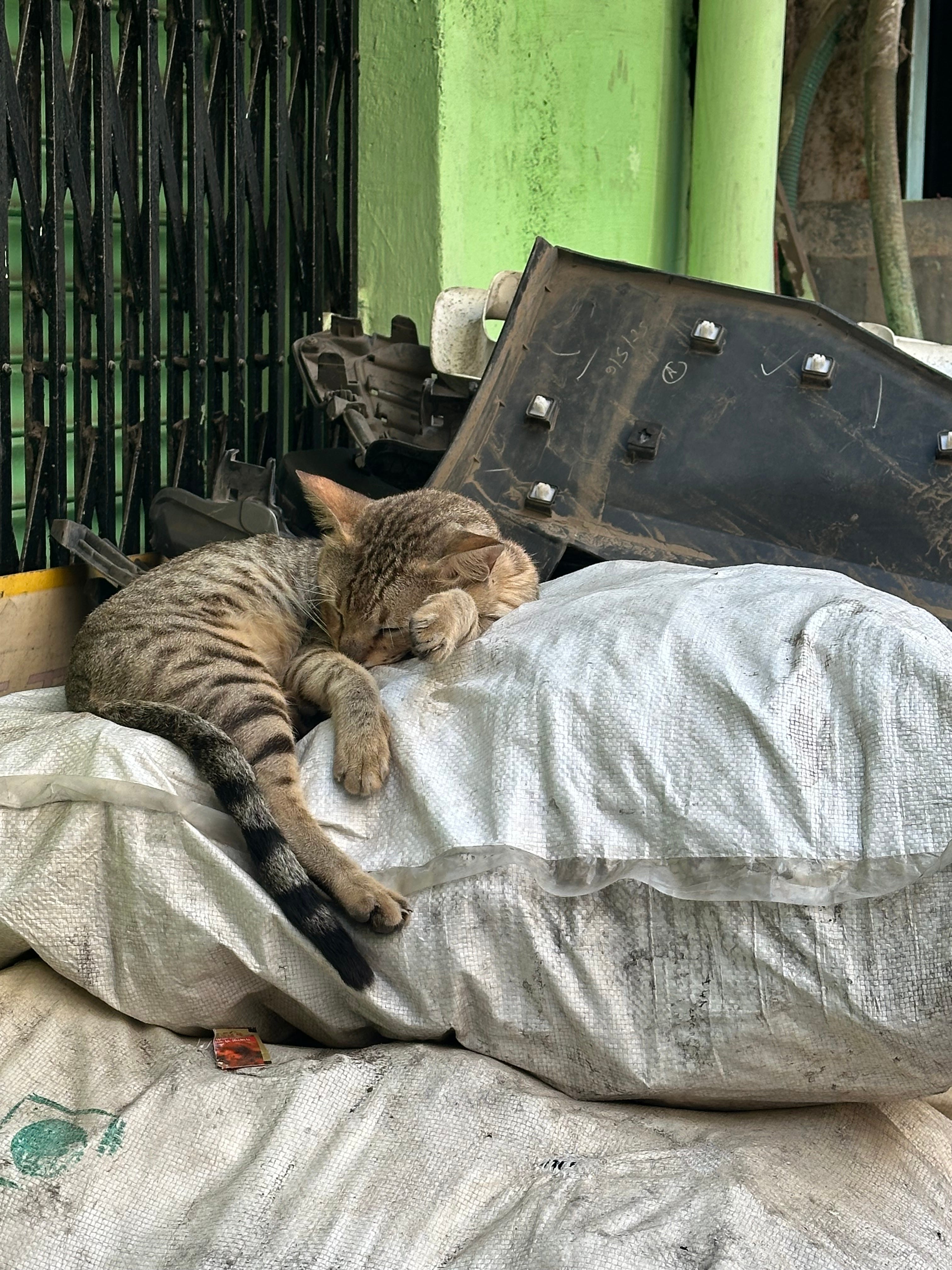
Deeper we went into slums. Our dragoman pulled us onto a side street and conversed with some workers. There, piled high, were entire fronts of cars—bonnet, bumper, headlights, grill and all. The alley itself was a plastic recycling factory. Its workers would break down the bonnets and bumpers into the smallest flakes, fill up bags with the material and sell it. Nor were they recycling just car parts, though the stacks of bumpers were most striking; around us were disintegrating anthills of scraps, plastic toys, bottles and other bits and pieces.
Onwards, through the tight gaps between buildings, and we came to a factory manufacturing machine parts. The furnace was located in the back of a sort of garage, where two men laboured. The heat, even from the entranceway, was unbearable. Stacked topsy turvy at the door were identikit iron bits, which one or the other worker had tossed to the floor after having pulled it from the flames. The toxic smell of smoke pervaded the space. O how their bodies must be scourged by fire!
Everywhere whirred industry; whirred electricity; effused steam; dripped pollution. Each slum building has, on average, three storeys, replete with one-room hovels, both for living and for working. In one, a group of three cooked chapatis on an open flame. Many hours later, they would dismantle their equipment, lie down and sleep on the same floor they had been standing on all day. In another, they make soap out of cooking oil. The overseer sits on his phone uncaringly blaring Islamic nasheeds as his men toil in heat and sweat. They look at us with hostility. Elsewhere, the workers are keen to show their production techniques. A leathermaker recycles worn and ragged leather into new material for purses, wallets and bags. An older man, legs-crossed, expertly carves up triple-ply cardboard boxes for resale. A group of young dyers play EDM as they push and pull and twist and manipulate the clothes which they have immersed in their great vats of dye.
Anarchy reigns only partially in Dharavi; somehow, there is a semblance of order, a sort of constitutional anarchy. The local government supplies water and electricity to every building, though much is requisitioned—stolen—by neighbours. The entire slum is owned by three men, which provides some strange legal security, but no economic security. Elections occur here as anywhere else in the world’s largest democracy. In Dharavi, the opposition usually wins. The Indian National Congress holds the local seats of the Mumbai Municipal elections and the Maharashtra regional assembly. Their representative in Maharashtra is an Ambedkarite Buddhist. The large Muslim population (about 40%) usually rallies against BJP-aligned Hindu nationalist parties.
The main thoroughfare of Dharavi is a vortex of sights, smells, people, animals and everything else you can imagine. From all directions flock crowds of all sorts and species. Unlike the parallel river-channel, filled with corrupted, stagnant water, the crowds here ebb and flow as a single organism. Most prominent among them are the Muslim families: women in black veils from head to toe, with some wearing green headbands inscribed Mashallah in Arabic; scores of children trailing behind them, with the young girls also fully covered; and men with full beards, often dyed in henna according to hadith, topi prayer hats and shalwar kameez. For a Westerner, such a sight of zealous religiosity could be shocking. Yet in all this penury and privation, without the distractions of modern life, with its vices, temptations and ambitions, without panem et circenses, without the ability to relieve, ignore or ameliorate one’s lot in life, why would God not be their only hope? Though under any system of religion, God must be the only hope, do not these conditions even starker make that truth?
And so I had been there, to Dharavi, to see them, and their homes; and yet, at my home, now and then, in my thoughts myself almost despising, I thought not of them; but instead wrongly dwelt on my outcast state, my fate, my state, Despair, that carrion comfort, even as one more rich in hope, even as one with friends possess’d; that though my lines and life are free, free as the road, they themselves are trapp’d, collar’d, kept, in bonds of rope made not by petty thoughts like mine own; that I all along had known their state, not of kings, O Swan of Avon, but of Job, or Ayyub as the Muslims call him, before I had ever looked upon it; that this scene was merely proof of the obvious; that seeing it had made no difference at all; that its memory, as all others, had faded, become dim from limpid, nor in eternal lines to time had grown, but wilt’d; that they remain there and I remain here; that I am powerless to effect any difference in their condition; but that this does not absolve me, as I, wretch, lay wrestling with (my God!) my God.